
Architecting GenAI and
RAG Apps with YugabyteDB
Want to rapidly deploy GenAI and RAG apps at scale?
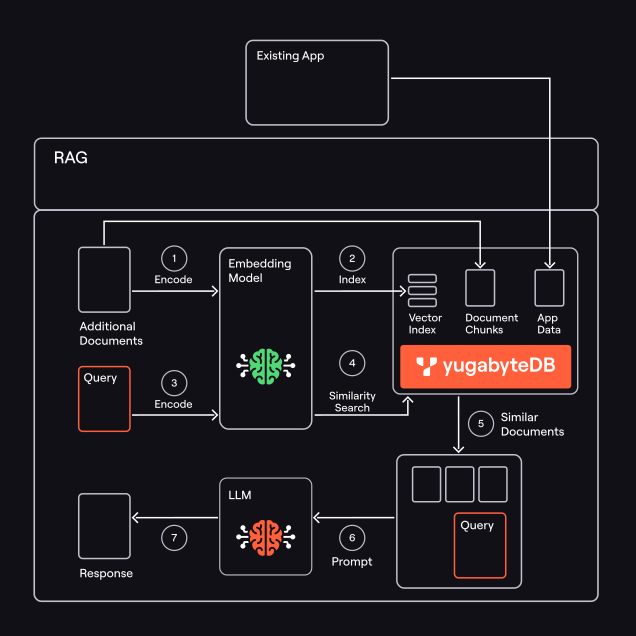
Most new applications include an AI component. Legacy apps may require retooling for Retrieval-Augmented Generation (RAG) functionality and to meet evolving business requirements.
GenAI alone isn’t useful. A RAG architecture enhances LLMs with your enterprise data.
YugabyteDB provides advanced vector indexing capabilities.
AI apps require high availability, ultra-resilience, and painless scale.
YugabyteDB’s distributed architecture delivers this and supports over 100M vectors.
Advanced Vector Indexing and Distributed SQL Capabilities
YugabyteDB combines the power of the pgvector PostgreSQL extension with an inherently distributed architecture. This future-proofed foundation helps you build AI-powered, data-driven applications—including RAG and Agentic AI—that demand high-performance vector search.
YugabyteDB’s unique approach to vector indexing addresses the limitations of single-node PostgreSQL systems when dealing with large-scale vector datasets.
Choosing the Right Database for GenAI Apps
| Feature | Standalone Vector Database | YugabyteDB with Vector Search |
|---|---|---|
| Vector Search | ||
| Horizontal Scalability | May offer | |
| Ultra Resilient | ||
| Consistency | Varies | Strong Consistency |
| Full SQL Support | Limited or none | |
| Data Model | Vector, maybe Document | Multi-Model: Vector, Relational, Document, Key-Value |
| Traditional SQL + Vectors | ||
| Familiar PostgreSQL | ||
| ACID Compliant | ||
| Only One Database Required | ||
| Low Operational Complexity | ||
| Low TCO (Small, POC Projects) | ||
| Low TCO (Full Production, at Scale) | ||
| Row-Level Security | ||
| Low/Zero Learning Curve | ||
| High Queries/Second | ||
| Query Flexibility | Vector | SQL + Vector |
| Geo-Located Data | May offer | |
| Deploy in Hybrid/Multi-Cloud | May offer | |
| Growing Postgres AI Ecosystem | ||
| Geo-Distributed Architecture | ||
| Open Source | May offer |
Learn More



FAQ
The best databases for GenAI and RAG applications combine vector search capabilities with traditional transactional features in a single platform. When you’re building AI database solutions, you need a system that handles vector embeddings for semantic search while also managing the operational data your application depends on.
Distributed SQL databases with native PostgreSQL compatibility and vector search extensions (like pgvector) deliver this combination effectively. You get ACID transactions for data integrity, full SQL capabilities for complex queries, and vector similarity search for semantic retrieval, all without juggling multiple systems.
Distributed SQL for AI applications offers a unified approach that standalone vector databases can’t match. Instead of running separate systems for operational data and vector embeddings, you handle both in one platform, eliminating data duplication and synchronization headaches.
You get ACID transactions, full SQL querying power, and semantic search capabilities without managing multiple tools. Your team uses one set of operational procedures, one backup strategy, and one security model.
This architecture delivers meaningful TCO savings while providing production-grade scalability and resilience that standalone vector databases struggle to match at enterprise scale.
Yes, modern PostgreSQL-compatible vector database solutions that utilize pgvector can manage hundreds of millions of vectors while maintaining ultra-low-latency query response times. The key is distributed architecture.
Single-node PostgreSQL hits scaling limits quickly when vector datasets grow large. Distributed PostgreSQL databases spread vector indexes across clusters, delivering horizontal scalability that grows with your data.
You add nodes to increase capacity without redesigning your application or experiencing downtime. Your team works with familiar PostgreSQL syntax and tools while gaining the performance needed for production AI applications.
Consolidating AI vector data with operational data in a single database eliminates an entire category of engineering problems. You don’t need to build synchronization pipelines between your transactional database and a separate vector store. Data consistency happens automatically through ACID transactions.
This unified approach also unlocks powerful query capabilities. Combine vector similarity searches with traditional SQL filtering, joins, and aggregations in one query. Find similar products, but only those in stock and in the customer’s price range, without round-tripping between databases.
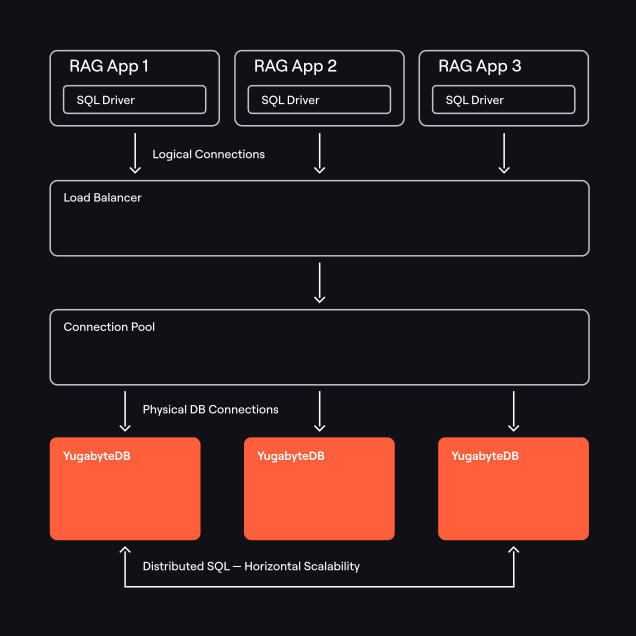
Distributed architectures scale your RAG application database horizontally. You add nodes to increase query throughput, storage capacity, and connection limits without complex migrations or downtime. When your RAG application goes from prototype to production traffic, the database grows with it.
Automatic data sharding and rebalancing handle growing vector datasets behind the scenes. As you ingest more embeddings, the system distributes them across the cluster and optimizes query routing. Active-active replication across regions provides both scalability and ultra-resilience, with automatic failover if an entire region goes offline.
Strong consistency ensures every node in your distributed database returns the same data at any given moment. For AI applications, this prevents generating responses based on stale or conflicting information because different parts of your system see different versions of the truth.
ACID-compliant transactions maintain data integrity when updating both operational records and vector embeddings. If you’re indexing a document and its metadata together, strong consistency guarantees that both updates succeed or neither does. This becomes critical when AI applications make real-time decisions based on current data.
Multi-region AI applications benefit significantly from a geographically distributed database architecture, especially when serving global users. Placing data geographically close to application instances reduces network latency, which directly impacts AI response times.
Beyond performance, multi-region deployment provides disaster recovery and business continuity without requiring you to build complex replication systems. For organizations operating internationally, regional data placement also addresses data sovereignty and compliance requirements like GDPR that mandate certain data remain within specific geographic boundaries.
Your GenAI database infrastructure directly determines how responsive your AI applications feel to users. Database latency adds to every interaction; if vector queries take hundreds of milliseconds, your chatbot feels sluggish, regardless of how fast your LLM responds.
Throughput capabilities set the ceiling on concurrent AI requests. Distributed architectures excel here because you scale query capacity by adding nodes rather than vertically scaling a single server. Distributed indexing accelerates both embedding ingestion and similarity search across massive datasets by leveraging multiple nodes simultaneously.
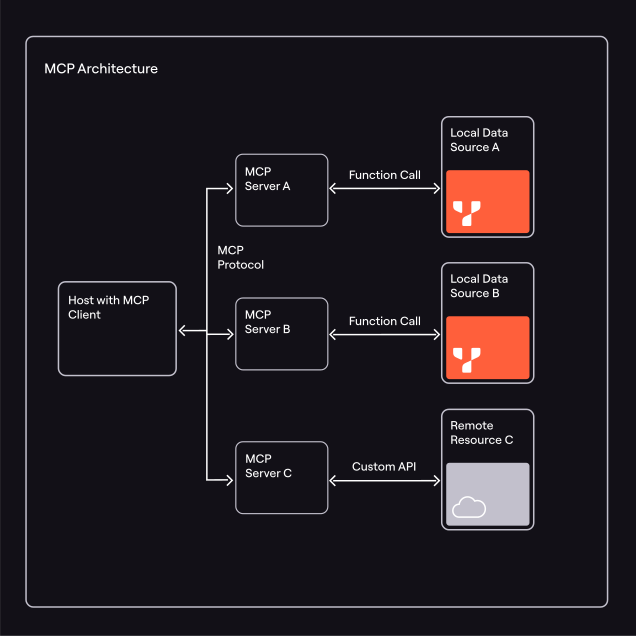
Agentic AI infrastructure demands databases that evolve alongside rapidly developing AI standards. Emerging protocols like MCP (Model Context Protocol) and A2A (Agent-to-Agent) are still maturing, so your data layer needs to be flexible enough to adapt.
Multi-modal database capabilities let AI agents work with different data types in one system, vectors for semantic search, relational tables for structured data, and JSON documents for flexible schemas. Strong transactional support ensures agents can safely read and write data without conflicts when multiple agents operate concurrently on shared data.
PostgreSQL-compatible distributed databases maintain wire-level compatibility, allowing migration with minimal code changes. Your existing queries, ORMs, and connection libraries continue working, so you don’t need to rewrite your application to gain distributed capabilities.
Keep your PostgreSQL knowledge and ecosystem integrations while adding the scalability and resilience that single-node PostgreSQL can’t deliver. Migration tools like YugabyteDB Voyager simplify moving from single-node PostgreSQL or legacy databases to a distributed infrastructure.
Purpose-built vector databases introduce operational overhead that’s easy to underestimate. Your team learns a new query language, backup procedures, monitoring tools, and security models, all separate from your existing stack. That’s two sets of operational runbooks and two systems to patch and upgrade.
Distributed SQL databases with vector capabilities let you consolidate. You use familiar SQL syntax for both transactional queries and vector similarity search, and your PostgreSQL expertise transfers directly.
One database means one security audit, one compliance framework, and one backup strategy. Schedule a YugabyteDB demo today!