Your Meko Questions, Answered

August 4, 2026
Since we launched Meko, interest has been overwhelming, and questions have been piling up: on Discord, on LinkedIn, and at in-person events.
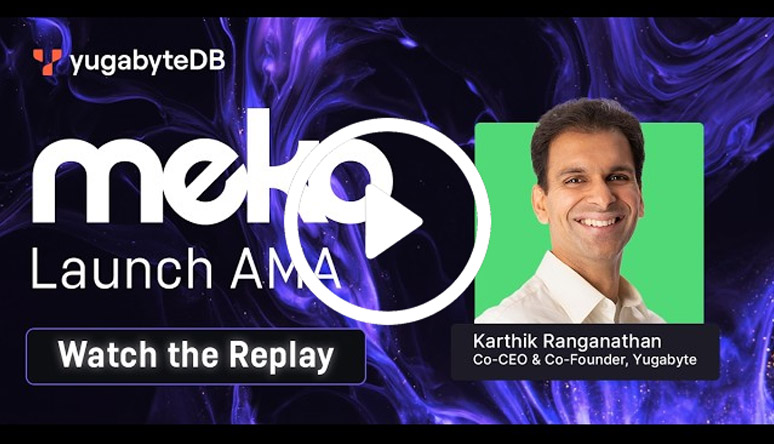
So, we challenged Yugabyte co-founder and co-CEO Karthik Ranganathan to sit down with Yugabyte developer advocate Heather Downing to answer as many as he could in 30 minutes.
This blog includes a brief recap of the highlights (and the full video replay!)
Why do we say “datapacks” and not “databases?”
A datapack is a portable, project-scoped store for an agent’s memory, knowledge, and decisions, relational, vector, and graph all at once, which is exactly why “database” was the wrong word for it.
Karthik has between 50 and 100 datapacks and uses about 25 of them every week. He walks through what actually lives inside them, including the shared datapack our go-to-market team checks before customer calls, so that sales, marketing, and support stop telling the same customer three different stories.
Repeatable agentic workflows versus one-off ones
Meko is built for the repeatable kind, and that choice shows up throughout the architecture. Karthik traces it back to the agents we were already running at Yugabyte before Meko existed, and to the specific waste that pushed us toward a shared data layer instead of letting every agent go spin up its own Postgres.
Why decision traces are not agent traces
If you already run Langfuse, this is the section to watch! A trace shows which calls ran, along with their inputs and outputs. A decision trace answers a different question that sits a level above that, and Karthik is clear about which one you should reach for when.
What keeps a poisoned memory from spreading?
The short answer is that it does not spread; the reason is architectural, not due to a filter or an extra model call. The longer answer covers who gets to promote something into shared memory, and how you trace a bad fact back to whoever introduced it.
What happens when an agent simply does not call the memory tool?
Karthik’s answer is refreshingly blunt (watch to hear his exact words!), and he shares what he personally does about it today and what we are building, so you have to think about it less.
He also gets into whether a team needs to migrate off Glean or Databricks before Meko is useful, how we see ourselves next to the unified memory pitch from mem0, Zep, and Letta, whether a CLI and a non-MCP API are on the way, and where we have landed on open source and licensing.
Watch the full conversation!
What’s Next?
Every question in this video came from someone who asked it in our Discord or dropped a comment on LinkedIn. We read every single one, and they help shape what we build next.
You can find more answers to Meko frequently asked questions here!
Please keep sharing your thoughts, and check out the resources below to learn more: