Deploying GraphRAG at Scale: Unified AI Architecture with Dify and YugabyteDB

January 28, 2026
This blog demonstrates how to turn scattered documents (SOPs, meeting notes, runbooks) into a connected knowledge graph that answers questions like “what depends on what?”, “who owns this?”, and “why was this decided?”
The challenge is not a lack of information; it’s a lack of connections. While popular solutions (Microsoft GraphRAG, Neo4j GraphRAG libraries, LlamaIndex graph tooling, and Neptune-based GraphRAG work well, they often require orchestrating multiple databases.
Our approach is simpler: Dify handles AI orchestration while YugabyteDB serves as the unified data backbone, consolidating vectors, relationships, and metadata in one operationally straightforward platform.
Mental Model – RAG (Retrieval Augmented Generation) vs GraphRAG
If you are new to the space, RAG (Retrieval Augmented Generation) stores unstructured data in a vector database. This can be searched semantically by a Large Language Model (LLM) to retrieve additional context for its query or tasked to retrieve relevant text and ask an LLM to answer. GraphRAG adds entities and relationships so the system can reason across connected contexts (multi-hop).
| Aspect | RAG | GraphRAG |
|---|---|---|
| What is retrieved? | Document chunks | Entities + connected context (graph) |
| Best for | Summaries and doc Q&A | Dependency, ownership, lineage, impact analysis |
| Typical question | “What does the doc say?” | “What depends on what, and why?” |
| Why it matters | Good recall, weaker structure | Strong explanations via relationship paths |
Why YugabyteDB is the Backbone for GraphRAG
- GraphRAG is not just “AI.” It is a mixed workload: ingestion writes, semantic reads, multi-hop traversal queries, and audit/provenance.
- YugabyteDB unifies everything in one PostgreSQL-compatible layer
- pgvector for embeddings
- Recursive CTEs for SQL-based graph traversal
- JSONB for flexible metadata properties
- Relational tables for metadata and ingestion state
- Most implementations split these capabilities across multiple databases (vector database + graph database + relational database). That increases cost, integration complexity, and operational risk.
- ACID (Atomicity, Consistency, Isolation, Durability) transactions matter: node creation, edge creation, embeddings, and provenance updates must remain consistent even under retries and concurrency.
- Horizontal scale and high availability matter: graphs and embeddings grow fast, and production systems cannot tolerate single points of failure.
Use Cases That Quickly Prove Business Value
GraphRAG proves its worth by reducing time-to-answer and improving decision-making in daily operations. To demonstrate ROI quickly, focus on use cases where teams face recurring pain:
- Scattered information
- Unclear ownership
- Hidden dependencies
- Slow impact analysis during change events
These use cases are strategically chosen because they are:
- Easy to start: Documents already exist
- Easy to demonstrate: The knowledge graph is visually compelling
- Easy to measure: Faster onboarding, quicker incident response, better risk assessment
Use Case A: Enterprise Knowledge Base (Institutional Memory)
Every organization has valuable decisions, lessons learned, and technical context documented somewhere, but it’s rarely connected or reusable.
This use case transforms existing internal documents into a living knowledge graph that surfaces expertise, decisions, and dependencies in seconds. This reduces onboarding time and prevents teams from reinventing past solutions.
What we organization ingest:
- Company handbooks, SOPs, runbooks, project documentation, meeting notes, technical specifications
- The goal isn’t just search; it’s preserving decisions, context, and expertise as people transition roles or leave
What we extract and connect:
- Entities: People, teams, projects, technologies/systems, processes, decisions
- Relationships: WORKED_ON, DECIDED, OWNS, USES, DEPENDS_ON, IMPACTS
Questions you can answer:
- “Who has experience with database migrations, and which projects prove it?”
- “What decisions were made about pricing strategy, and who was involved?”
- “What technologies depend on legacy Oracle, and which teams own them?”
Detailed Demo Narrative: GraphRAG in Action (Based on Use Case A)
For this demo, the system works with three operational documents (either your own or anonymised/sample versions). Input the three operational documents mentioned/shown below.
- Solution Design Document – Microservices dependency map (API Gateway, User / Order / Payment services, YugabyteDB, Redis)
- Runbook – Deployment procedures and ownership by team
- Incident overview – Analysis of a payment-service outage (for example, “Nov 2024 Payment Service outage”)
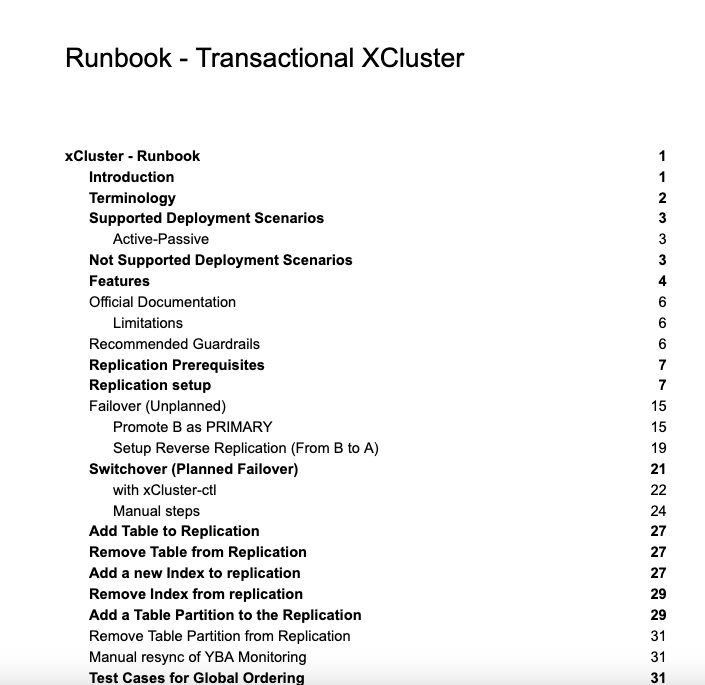
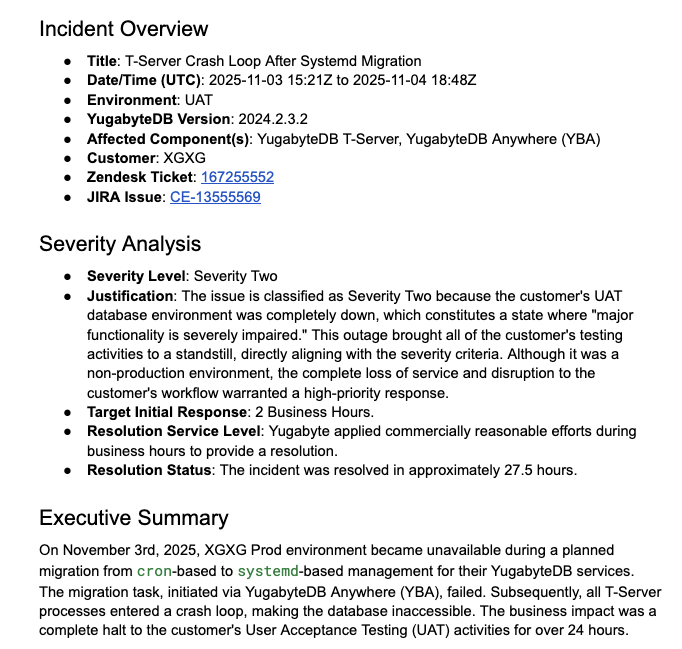
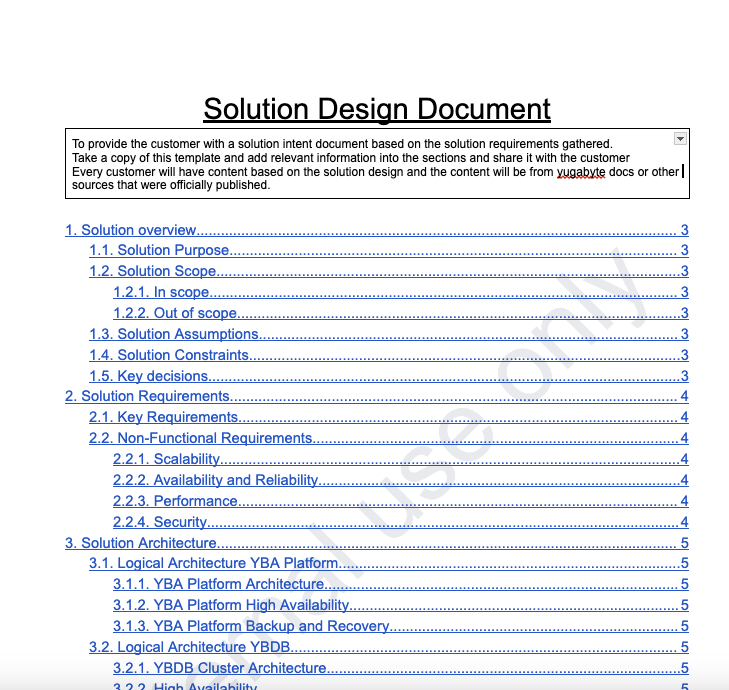
Example: The system extracts 47 entities and 83 relationships automatically.
Question 1: “What breaks if YugabyteDB goes down?”
Answer in 3 seconds(Appox):
Direct Impact:
- Payment Service → transaction records blocked
- User Service → authentication fails
- Order Service → order history unavailable
Cascade Impact:
- API Gateway → can’t authenticate users
- Checkout Flow → completely blocked
- Order Processing → transactions fail
Ownership: Platform Team (YugabyteDB) + Product Team (affected services)
Evidence: Links to Solution Design doc Section 3.2, Incident Overview page 2, Runbook Section 5.4
Traditional approach: 2+ hours asking teammates and searching documents
GraphRAG: Approximate ~3 seconds with complete context
Reference Architecture
The architecture prioritizes operational simplicity. Dify handles AI orchestration, a lightweight FastAPI service manages graph operations, and YugabyteDB serves as the underlying unified database layer
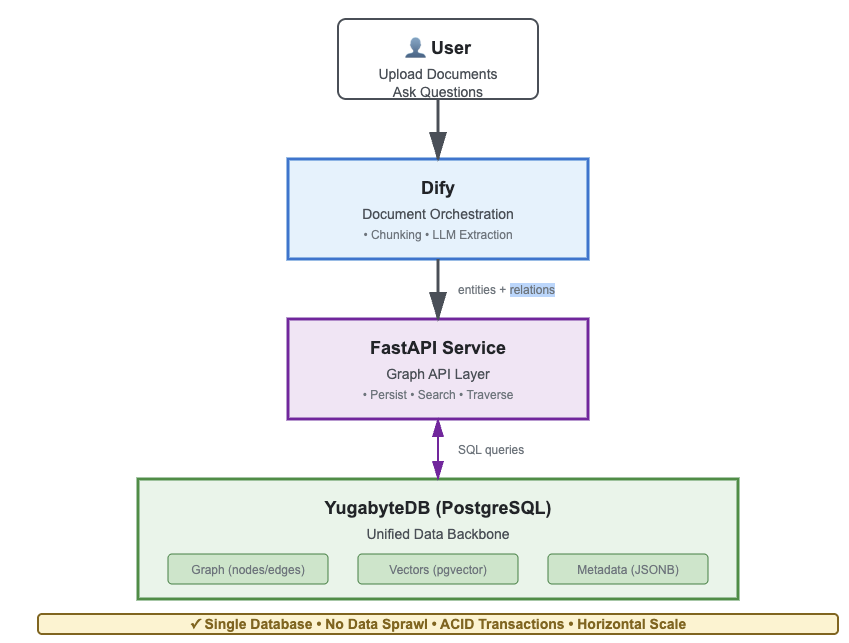
- User – Upload documents and ask questions
- Dify – Orchestrates document processing and LLM extraction
- FastAPI Service – Provides graph API layer (persist, search, traverse)
- YugabyteDB – Unified data backbone with three storage types inside
Dify Workflow to build the Knowledge Graph
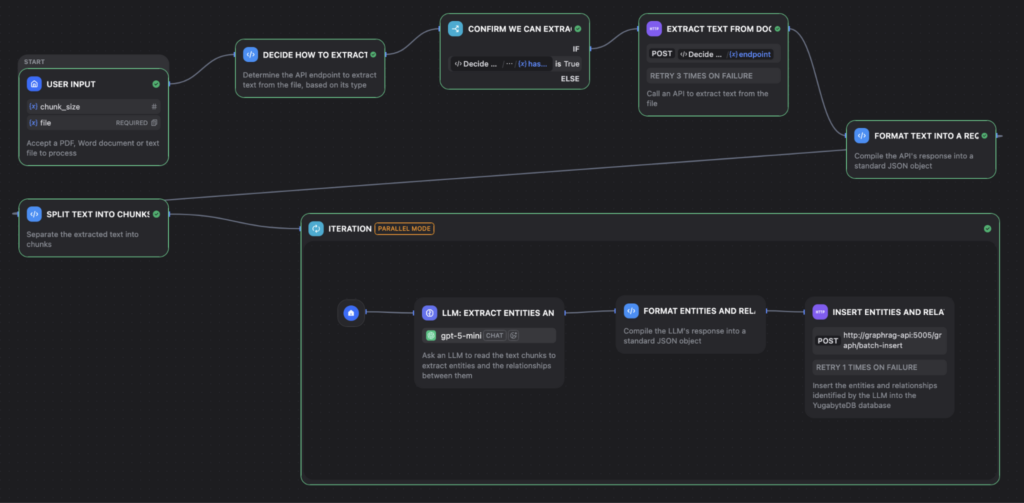
The diagram below shows the end-to-end workflow we built in Dify.ai. It mirrors the process steps described above:
- It ingests input documents
- It generates GraphRAG outputs (entities and relationships)
- It stores the resulting knowledge graph (nodes, edges, and metadata) in YugabyteDB
Implementation Steps
Refer to the Github Repo which has step by step instructions to implement the Dify.Ai workflow and integrate it with YugabyteDB.
Limitations and Next Steps
This blueprint demonstrates the principles behind GraphRAG and shows how YugabyteDB can provide a simple, unified database. From here you can extend and optimize it based on your workload or explore other implementations.
What to consider:
- Framework compatibility: Some advanced GraphRAG frameworks assume PostgreSQL 16+ Apache AGE (Cypher). YugabyteDB doesn’t currently offer that exact stack, so those tools may need adaptation (or a dedicated graph layer).
- Why one database still wins: For most dependency-mapping and knowledge-management use cases, keeping vectors + metadata + relationships in a single distributed, ACID-consistent database avoids multi-database sprawl and simplifies operations.
- Graph traversal trade-off: Recursive CTEs are strong for moderate traversals; for very deep/high-cardinality multi-hop queries, native Cypher/property-graph engines can be more optimized.
Next steps:
- Operationalize: Add observability, caching, re-embedding workflows, and guardrails (depth limits/timeouts/pagination).
- Optimize: Tune indexes, denormalize hot paths, and precompute common traversals where needed.
- Evolve: As PostgreSQL compatibility and extension support expand, you can adopt richer graph tooling without the need to change your storage foundation.
Conclusion
GraphRAG turns documents into connected, explainable knowledge by combining semantic search with relationship traversal. Dify provides the orchestration pipeline. FastAPI keeps the API layer clean and extensible. YugabyteDB serves as the unified database that stores graphs, vectors, and metadata in a single PostgreSQL-compatible, distributed database.
The end result is a robust system that’s simpler to operate, cost-efficient to scale, and easier to take from prototype to production-ready platform.
Want to discover more YugabyteDB integrations? Check out this recent blog which details how to integrate YugabyteDB Anywhere metrics with Dynatrace.