Why I’m Returning to the Distributed SQL Summit

June 10, 2026
As a Developer Engagement Manager at Yugabyte, my role is to help engineers and developers understand what YugabyteDB actually does and how it works.
I create technical content, speak at conferences, run demos, and work closely with the product and engineering teams on some of the most interesting developments in distributed SQL. Most recently, I’ve been working with Meko, Yugabyte’s new agent-native data infrastructure, which provides AI agents with a durable, consistent memory layer built on YugabyteDB.
When I signed-up for Distributed SQL Summit (DSS) Atlanta last November, I was still getting my hands dirty with YugabyteDB. I wanted to hear from engineers who had actually run it at scale, and attending DSS gave me that insight. The conversations from that day directly shaped how I think about YugabyteDB’s strengths and features, and influenced how I talk about it now.
My first blog shares why I think DSS Atlanta was worth attending and why I’ll be at DSS Mumbai on June 17. If you’re in Mumbai for KubeCon India and you care about distributed databases, AI infrastructure, or both, then this is the place to be!
DSS Atlanta, 2025
Last November, I flew to Atlanta for KubeCon + CloudNativeCon – something I had planned and been looking forward to for some time. I didn’t expect how much value I would gain from the co-located event I signed up for there – Yugabyte’s flagship annual event: the Distributed SQL Summit.
The Distributed SQL Summit (DSS) showcases how you can use YugabyteDB to power GenAI applications, explores real-world use cases, and provides practical demonstrations of best practices to help you build ultra-resilient, globally distributed systems at scale.
I had recently started working at Yugabyte, so I figured attending DSS would be a great way to put faces to names and get a clearer idea of what made YugabyteDB different.
I walked out with a notebook full of things I actually wanted to try, a much sharper picture of what databases look like at a serious scale, and the start of conversations that eventually led to me joining this team.
First Impressions
The vibe was different, and that mattered. Most database conferences still feel like trade shows with random talks sprinkled on top.
There is usually a sponsor hall, a keynote that doubles as a product launch, and a lot of badge scanning. But DSS Atlanta wasn’t that:
- Instead of a huge conference hall, the room was small enough to seem more like a really good meetup than a stuffy conference.
- Talks were technical (even the hallway conversations!) It didn’t feel like anyone was trying to sell me something.
- The YugabyteDB team was there, but not in a performative way. The speakers carried the event. Many were engineers actually running systems in production, or experts from businesses using YugabyteDB and sharing practical examples of what to do (or not do!)
I also met many genuinely sharp and interesting people at the summit. Folks from Gartner, multiple distinguished engineers, and tech teams who had clearly spent years dealing with real scale. Those side conversations mattered just as much as the presentations and demos.
Customer Stories
The session that stuck with me most was presented by Brad Dietrich from Shopify. He walked through their shift from tens of thousands of MySQL nodes toward distributed SQL, and more importantly, detailed everything that made that transition hard.
A few numbers stood out:
- Operations in 175 countries
- Workloads hitting around 20 billion QPS at peak
- A YugabyteDB cluster is already pushing around 200,000 QPS on roughly 7,000 cores
- 1.4 PB of data
But, big as they are, the numbers were not what surprised me most. The honesty was:
- A 20-year-old application with 1,500 highly normalized tables does not quietly become distributed SQL native.
- Indexes behave differently, and primary key design suddenly matters more. Write quorum across regions introduces real latency constraints, and ’around 35ms’ is not theoretical anymore.
- Perhaps most importantly, you have to retrain your application engineers to think about the database differently.
Brad’s talk captured something DSS does unusually well: it focused on the messy middle. Not whether distributed SQL is a good idea (that question already felt settled in the room), but what might break after you’ve made the leap to adopt or migrate.
The session, where Fiserv CTO/CIO Jay Duraisamy shared the real-world use cases that drove their move from legacy SQL and NoSQL to YugabyteDB, had a similar tone. This global payments system organization walked through how they evaluated and adopted distributed SQL for mission-critical workloads.
Unexpected Wins
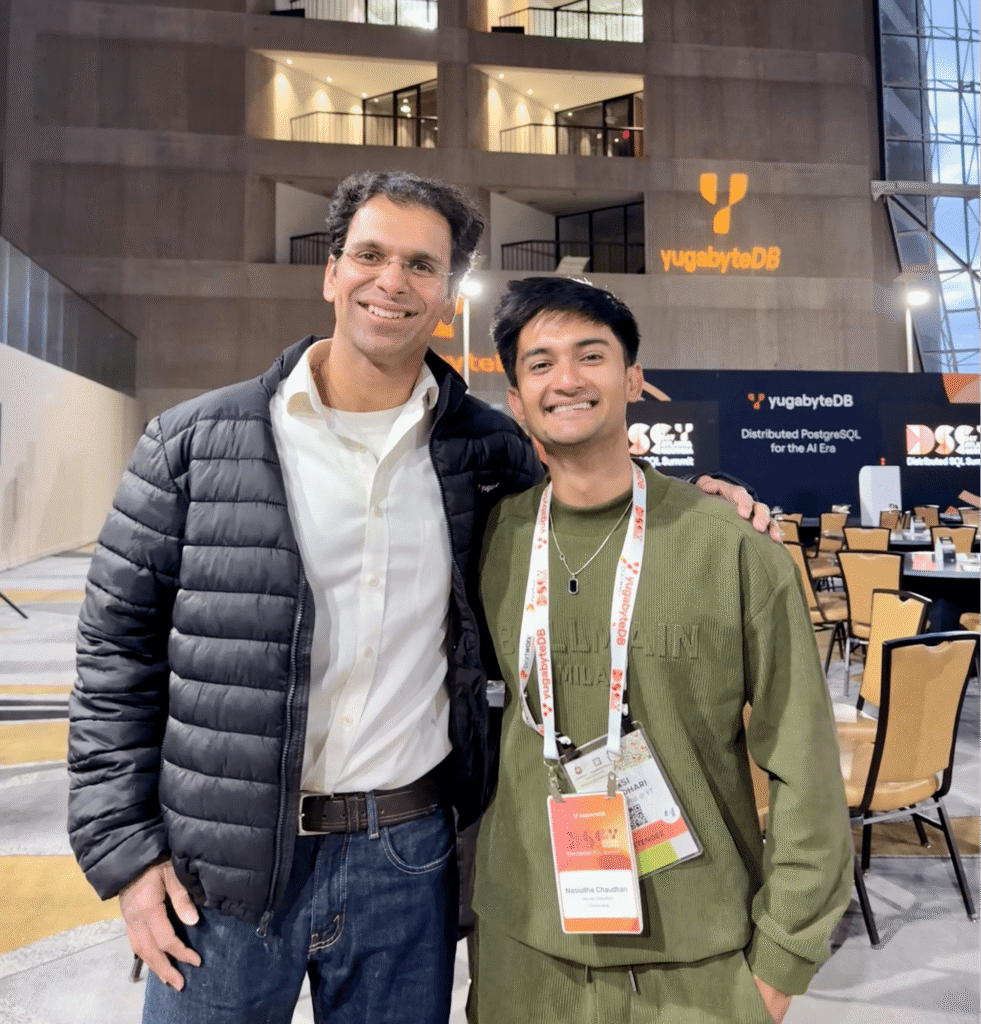
Between the talks and the happy hour, I ended up in a long conversation with one of the Yugabyte co-founders, Karthik Ranganathan. It was not a recruiting pitch. It was just an engineer talking to an engineer, asking real questions and digging into real use cases.
That conversation is a big part of why I am now on the inside, writing this blog, rather than sitting in the audience.
I think that says something important about DSS. It is exclusive enough, and the people behind it are accessible enough, for real conversations to happen. You don’t get that enough at events.
DSS Mumbai – June 17
The next DSS, co-located with KubeCon + CloudNativeCon India, is in Mumbai on June 17.
This year’s schedule is stacked with engineers and experts who’ve built at scale with YugabyteDB. They understand that correctness, latency, and reliability are not optional; the database is not an implementation detail, it is the system that everything else depends on.
The event includes presentations by major companies, including:
- NPCI
- Sharekhan
- Razorpay
- Rakuten
- HDFC Bank
- FynDNA
- Kotak Mahindra Bank
Event Highlights
I’m looking forward to the planned deep dive into Meko, the new agent-native data infrastructure for collective memory, shared knowledge, and decision traces. That session will show you how to build a durable state for AI agents on a distributed SQL foundation.
There’s also a new YugabyteDB release expected during KubeCon, so the keynote will feature the latest and most exciting YugabyteDB updates.
Who Should Attend DSS?
If you are a backend or platform engineer working on systems that matter, this is worth your time.
You won’t become an expert in distributed SQL in a few hours, but you will hear how teams who’ve built with YugabyteDB think about trade-offs, failure modes, and the problems that crop up when you scale.
A Small (Honest) Note
I now work at Yugabyte, so I have some natural bias. But that is not why I am going back to DSS.
I am going back because last year I learned things I actually used, and this year’s lineup looks even more production-heavy than Atlanta, which I find exciting.
Conclusion
If you are already going to KubeCon India, the cost of being at DSS Mumbai is zero. So, if you have registered for DSS Mumbai and been allocated a place, come!
At worst, you spend a day around people who care about the same important problems you do. But the best outcome is that you walk out with a notebook that changes how you think about distributed systems.
If you have a place at this year’s event, find me there – I would much rather meet people in person than over another video call!
Due to popular demand, Distributed SQL Summit Mumbai is now at capacity, and we are unable to take any further registrations for the June event. The overwhelming response we have received demonstrates the strong user interest in YugabyteDB’s modern, distributed, AI-ready data infrastructure.
Want to make sure you don’t miss out in future?
Join the priority access list to be among the first to hear about upcoming Distributed SQL Summit events, receive early registration access, and secure your spot before registrations open to the general public.
Want to learn more? Check out DSS Atlanta sessions on demand.