“Where Were We?” Watch Meko Give AI Agents a Shared Context

July 16, 2026
Developers and engineering teams building production multi-agent AI applications need their agent systems to learn and improve collectively, not just store and retrieve data.
36.9% of multi-agent failures stem from inter-agent misalignment. This means agents working from different context, re-fetching what a teammate already retrieved, and re-explaining state that should be shared.
This blog shares Meko’s agent memory features and showcases a short video by Yugabyte Developer Advocate Heather Downing that demonstrates exactly how Meko gives AI agents persistent, shareable memory.
What is Meko?
Meko is an agent-native data infrastructure, built on top of YugabyteDB, that enables multi-agent systems to share context.
Instead of giving each agent its own isolated memory, Meko gives your entire system a memory that compounds. When one agent learns something from a conversation, a user interaction, or a data update, that learning is immediately available to every other agent in the system.
Meko replaces the patchwork many teams have bolted together over time (Postgres here, pgvector there, a separate graph database for memory, an object store for conversations, an observability layer for traces) with a single unified data layer.
Vector, relational data, graph, and search all live in a single distributed, Postgres-compatible database, exposed to any agentic framework via a single MCP endpoint. It works with Claude, Cursor, and Codex today, with more frameworks on the way.
Demo Time: No Context? No Problem
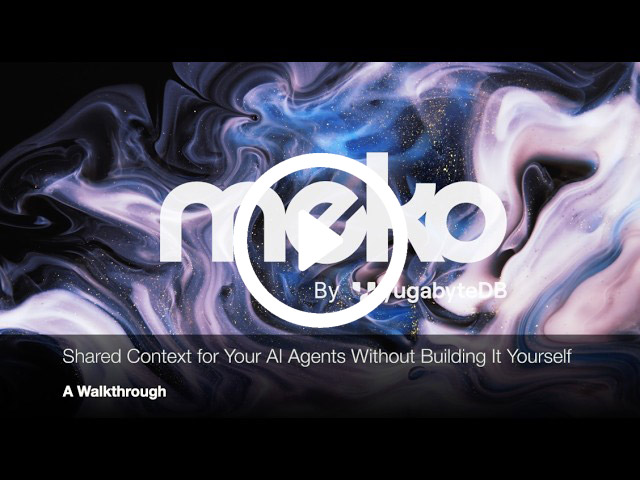
Every developer recognizes the feeling of reopening their coding agent in a completely fresh session with nothing in context, no local files, and project memory turned off.
In this demo, Yugabyte’s Heather Downing asks one question: “Where were we?”
Back come yesterday’s decisions and unfinished tasks, all pulled live from Meko.
The demo walks through how Meko works: private context that agents write automatically as they go, retrieved via vector search plus graph traversal, all running server-side, off the context window.
Then the real differentiator: once you promote the first agent’s knowledge to shared, a second agent that’s never seen the project can answer questions from it instantly. Decision traces show exactly what each agent actually did, down to every retrieval and tool call.
Watch to see token costs drop in real time as shared context fills in.
What Makes Meko Different?
Compounding memory: One agent’s learning instantly becomes a system-wide advantage. Meko handles entity extraction, graph updates, and per-agent scoping automatically.
Shared knowledge: Conversations, real-time data feeds, SQL tables, and documents are continuously processed into one knowledge layer that every agent can access and contribute to.
Decision tracing and complete auditability: Every retrieval, memory update, and knowledge share is traced end to end, so you can see exactly what your system knows, how it came to know it, and what that learning cost in tokens and latency.
Any agentic framework: Meko connects to any agentic framework, chat app, or coding harness via a single remote MCP endpoint and runs on a distributed, serverless hosted service for cost-controlled scaling and no extras to stitch together.
Winning the Economic Argument
Without shared memory, multi-agent systems can burn many more tokens than a standard chat interaction. Most of that is pure coordination overhead: agents re-fetching what a teammate already retrieved, and re-explaining context that should simply be shared state.
Meko eliminates that redundancy at the infrastructure level. Because retrieval, embedding, and indexing all run server-side, none of it consumes your agents’ context windows, and once one agent learns something, no other agent has to spend tokens re-deriving it.
You can watch this play out in the demo above. Per-conversation token costs visibly drop over time as the shared context layer fills in. The savings extend to infrastructure, too: a serverless architecture that tiers cold data to object storage, and a unified data layer instead of a patchwork of separate vector, graph, and relational databases to run and pay for.
All this ensures your token budget and your infrastructure spend go toward work, not redundancy.
Try Meko Today
Reading about collective memory is one thing, watching agents actually build on each other’s learning in real time is another. The demo above shows how Meko provides AI agents with persistent, shareable memory:
- A coding agent recalling a project in a fresh session with zero context
- A second agent instantly using the knowledge the first one learned
- Full decision traces showing exactly what each agent did
These three moments show the power of Meko in action: memory that persists, knowledge that compounds, and a system you can fully audit.
Ready to go further?
- Try Meko for free – sign up today!
- Dig into the docs.
- Join the Discord server to talk to the team building Meko