The Beautiful Game: Winning at Scale with a Multi-Agent Strategy

June 2, 2026
On June 11, the first four FIFA World Cup matches will kick off in a six-hour window. From New York to London, Sao Paulo to Berlin, tens of millions of fans will log in daily to the same applications to watch games and place bets.
The expanded 2026 tournament will host a record 104 games in 39 days. By July 19, the tournament will have generated more “in-play handle” than any single sports event in history.
There is no downtime or window to catch up during the event, which means:
- A sportsbook that can’t support an in-play wager before kickoff will lose its customer to a competitor.
- A streaming platform that lags (and where viewers can hear their neighbors cheer a goal seconds before it happens on their own screen) will lose its audience.
To support a seamless World Cup experience, iGaming and streaming platforms must deliver ultra-resilient, scalable, and reliable services in real-time, from anywhere in the world.
In this blog, we consider the FIFA World Cup as a use case for any peak event that drives traffic to unprecedented levels on your platform. We’ll dive into why the platforms that will succeed are building multi-agent systems on a unified data infrastructure to handle seasonal and event-driven traffic spikes.
One AI Assistant is Useful. A Multi-Agent System Wins the Game.
Picture an England vs Brazil group-stage match in stoppage time. Within a 200-millisecond window, your sportsbook has to:
- Pull up betting history, behavior patterns, and live session context
- Continuously re-price each leg of a complex parlay as the odds move.
- Run real-time fraud checks on device, speed, and identity signals
- Apply responsible gambling rules across multiple countries and jurisdictions
- Produce in-sync outputs, such as customer messages, trader notes, and audit logs
How are you supposed to bet on the game if your device shows the action 3 seconds after everyone else?
Streaming platforms experience similar pressures. Within seconds of the ball hitting the back of the net, your streaming stack has to:
- Sync session state and authentication across millions of concurrent viewers
- Trigger a personalized highlight clip for fans who opted into smart alerts
- Update real-time stat overlays in multiple languages
- Insert region-appropriate dynamic ads in the next break
- Apply broadcast rights, language preferences, and content filters per viewer
- Detect ad fraud and bot traffic before it skews the analytics
A few hundred milliseconds of delay is more than a single-task problem; it’s a coordination problem at scale. The businesses that hold up during peak demand haven’t just added more agents to their platform; they’ve constructed a highly skilled multi-agent team.
But having a great team isn’t enough if they don’t work well together. Messi, Ronaldo, and Mbappé are outstanding players, but they can’t do it alone — they need reliable teammates who play their roles effectively. There is no value in a team that doesn’t know how to play well together; you need to build a strong, strategic lineup.
The same applies to your multi-agent system. You need a team of agents that create reliable, consistent shared outputs and then draw on that single source of truth. A successful organization won’t have the most agents; they’ll have ones that draw on and contribute to a memory layer that transforms independent processes into shared knowledge.
Winning enterprises are now unifying all systems into a single, agent-native data layer purpose-built for agentic applications:
- Collective Learning: Instead of per-agent learning, the unified data layer ensures that, when one agent learns, your entire system benefits from the knowledge. This architecture creates a single source of truth for agents to work from.
- Efficient Economics: Per Anthropic, a multi-agent system typically uses 15x more tokens than a chat session, mostly due to redundant retrieval and inter-agent coordination. A unified data layer can cut this overhead and keep the system economically reasonable.
- Agent-Native Primitives: Native actions, such as “add knowledge” or “record conversations,” where agents can interact directly with data constructs, fast, reliable outputs, and reduce complex data modeling.
- Ready for Regulation: A traceable audit trail of what your agents learned and how they shared that knowledge.
Fielding a Multi-Agent System
So, who should be part of your lineup?
Our recent blog ‘Implementing multi-agent AI with YugabyteDB vector,’ explored five core AI components for a multi-layered system:
- YugabyteDB Vector
- Embedding Model
- Writer Agent
- ComplianceBot
- FraudDetectionBot
For our FIFA World Cup use case, we will leverage these agents to build a strong agentic team for high-performing iGaming, sports betting, and live streaming applications.
The Retriever
Pulls in live and historical context from a shared memory layer. This includes player behavior, session activity, viewer history, language preferences, and trade data. The Retriever keeps every other agent informed at scale and determines whether two agents can see the same bet state at the same instant. If it lags, everything downstream is working with bad inputs.
The Fraud Detector
The Fraud Detector is a critical part of the lineup as 83% of iGaming operators reported increased fraud over the past year. It evaluates risk signals in real time across betting and streaming, including bet velocity, device, identity, ad impression patterns, and viewer authentication. Fraud volume surges nonlinearly during marquee events, and a specialist agent can be scaled independently when attacks spike, without scaling the rest of the stack.
The Risk Scorer
Assesses exposure across the operation. On the sportsbook side, that means bets, parlays, and cash-outs. On the streaming side, it covers dynamic ad inventory and live recommendation scoring. As bet builders get more complex, this becomes one of the most important controls in the system. Running those checks in parallel against shared memory is what keeps cash-out, in-play pricing, parlay grading, and real-time personalization responsive at peak.
The Writer
Turns each system decision into clear, written output. That includes customer prompts, trader notes, regulator logs, multilingual stat overlays, and live captions during a stream. This is where AI is most visible, and where mistakes are easiest to spot. The Writer keeps the user-facing surface correct and aligned with the rest of the team.
The Compliance Expert
Applies rules in real time across markets. On the betting side, that means deposit limits and self-exclusion lists. On the streaming side, it covers broadcast rights, age gating, and regional content restrictions. It turns responsible gambling, content compliance, and regulator scrutiny from reactive processes into continuous parts of the platform.
A Unified Data Layer is a Game Changer
You can field every specialist agent on the market, but without a shared memory layer keeping them in sync, they’re independent processes, not a team.
A shared, compounding memory layer turns five agents (or fifteen) into a team that can withstand peak events and traffic spikes, such as the FIFA World Cup, season finales, live concerts, and other massive online events.
To support exponential scalability, a multi-agent architecture needs:
- A single source of truth: No gaps between transactional data, behavior data, and compliance records. Every agent reads the same data at the same real-time instant.
- Sub-second data freshness: Even under peak load, the data must be refreshed in milliseconds to ensure accuracy and reliability.
- Consistency across regions: Systems must remain in compliance with regional regulations while ensuring global data synchronization.
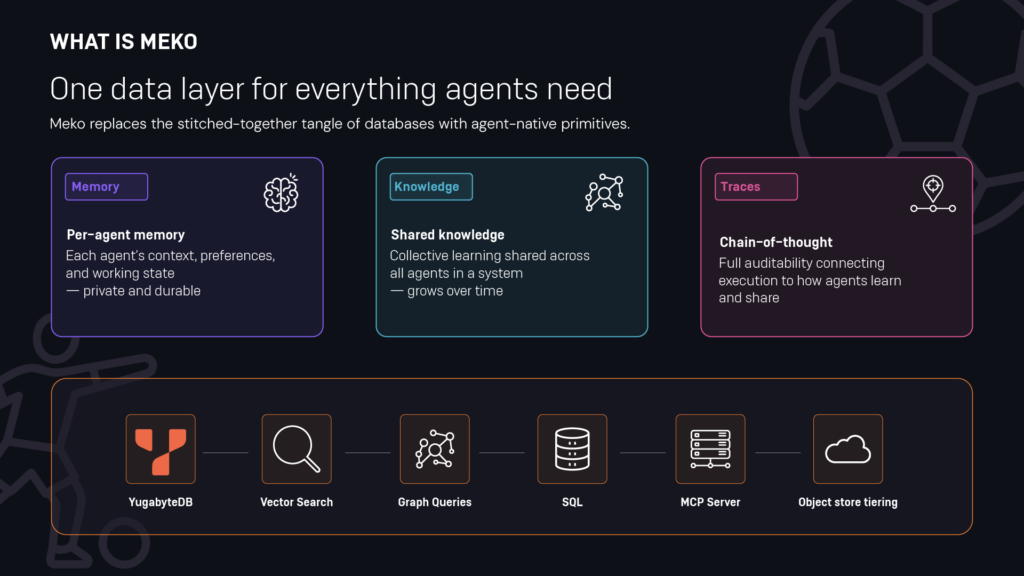
This is why Yugabyte built Meko: the agent-native data infrastructure for collective memory, shared knowledge, and decision traces.
Meko gives every agent a continuously updated knowledge layer they can read from in real time. One agent’s learning instantly becomes the team’s, and every retrieval, memory update, and knowledge share is fully auditable.
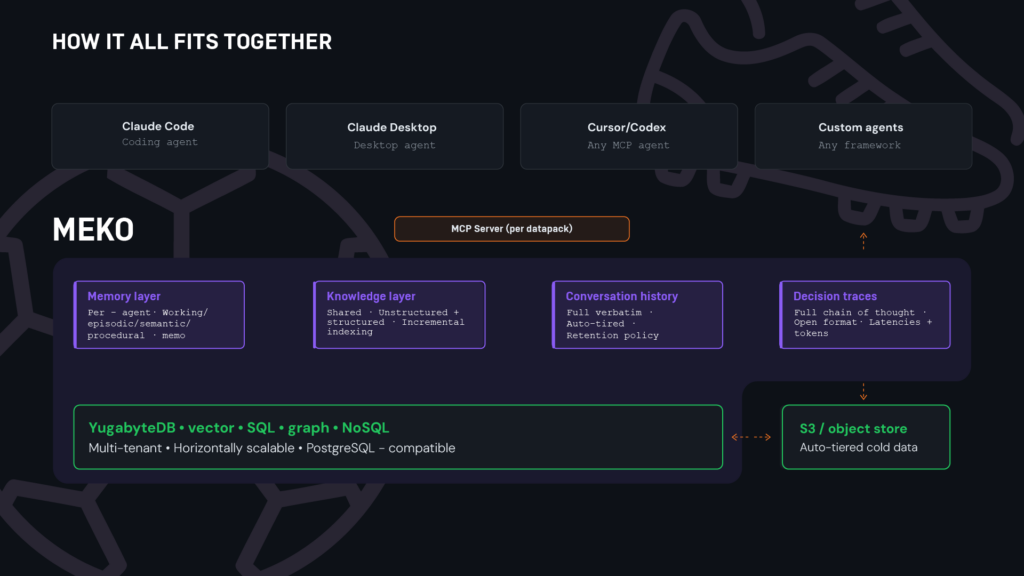
Meko connects to any agentic framework through a single MCP endpoint, including Claude, Cursor, and Codex (with more on the way). It runs serverless and multi-tenant, and unifies vector, SQL, graph, and search in one place.
During peak events, like the FIFA World Cup, Meko ensures your agentic applications can scale fast, securely, and reliably across global regions.
Underneath Meko sits YugabyteDB, the distributed SQL database that powered Paramount+’s live stream of Super Bowl 2024 to 125 million viewers, and helped 01.Tech double their betting throughput from 5,000 to 10,000 QPS.
Together, Meko and YugabyteDB provide your agentic system with the collective memory layer it needs and a secure, distributed database foundation to run on.
The Final Whistle
During major live sporting events, peak traffic reaches unprecedented levels, and customers expect a flawless in-the-moment experience. The right data infrastructure is what separates the platforms that win from the ones that fail.
The gaming, betting, social, and streaming platforms that will win future market share won’t be the ones with the most agents. They’ll be the ones who invested in a solid, secure data layer for agents that learn together, with collective memory, shared knowledge, and decision traces. And alongside that, a PostgreSQL-compatible and horizontally scalable distributed SQL database built to provide reliable and ultra-resilient live event experiences.
To learn more, book a demo with a YugabyteDB database and AI expert, try YugabyteDB Aeon for free, or request early access to Meko.
You can also join the Yugabyte team at our upcoming rooftop Happy Hour event (June 10) inspired by the world’s biggest tournament. Connect with cloud leaders, architects, and innovators to discuss modernization, distributed SQL, and resilient application infrastructure. Find out more and register.